

Today, if you walk into a top-tier wellness center, a longevity clinic, or an elite sports recovery facility, you are very likely to see a specific pairing of technologies: a hyperbaric oxygen chamber right next to an advanced red light therapy bed.
It’s not an accident and it’s not a simple marketing ploy to package expensive services.
Hyperbaric Oxygen Therapy (HBOT) and Red Light Therapy, also known as photobiomodulation, were developed as completely separate treatments. However, breakthrough clinical research has uncovered a profound biological truth: when used in combination, these two therapies create a powerful, natural synergy at the cellular level. They don’t just sit next to each other in a room, they actively supercharge each other.
Why Are Clinics Combining HBOT and Red Light Therapy?
For years, these treatments were offered separately by recovery clinics. Deep tissue healing was the goal for HBOT, while red light and near-infrared (NIR) therapy became popularized for skin rejuvenation and localized inflammation.
Practitioners have however noted that patients who used both technologies experienced remarkably faster recovery times, increased mental acuity and systemic anti-aging effects compared to those using either technology alone.
That’s because it’s buried deep in our cellular machinery. To understand why this combination works so incredibly well, we have to look at how our cells make energy, deal with stress, and repair damage.
Understanding HBOT: Supplying Oxygen to the Cell
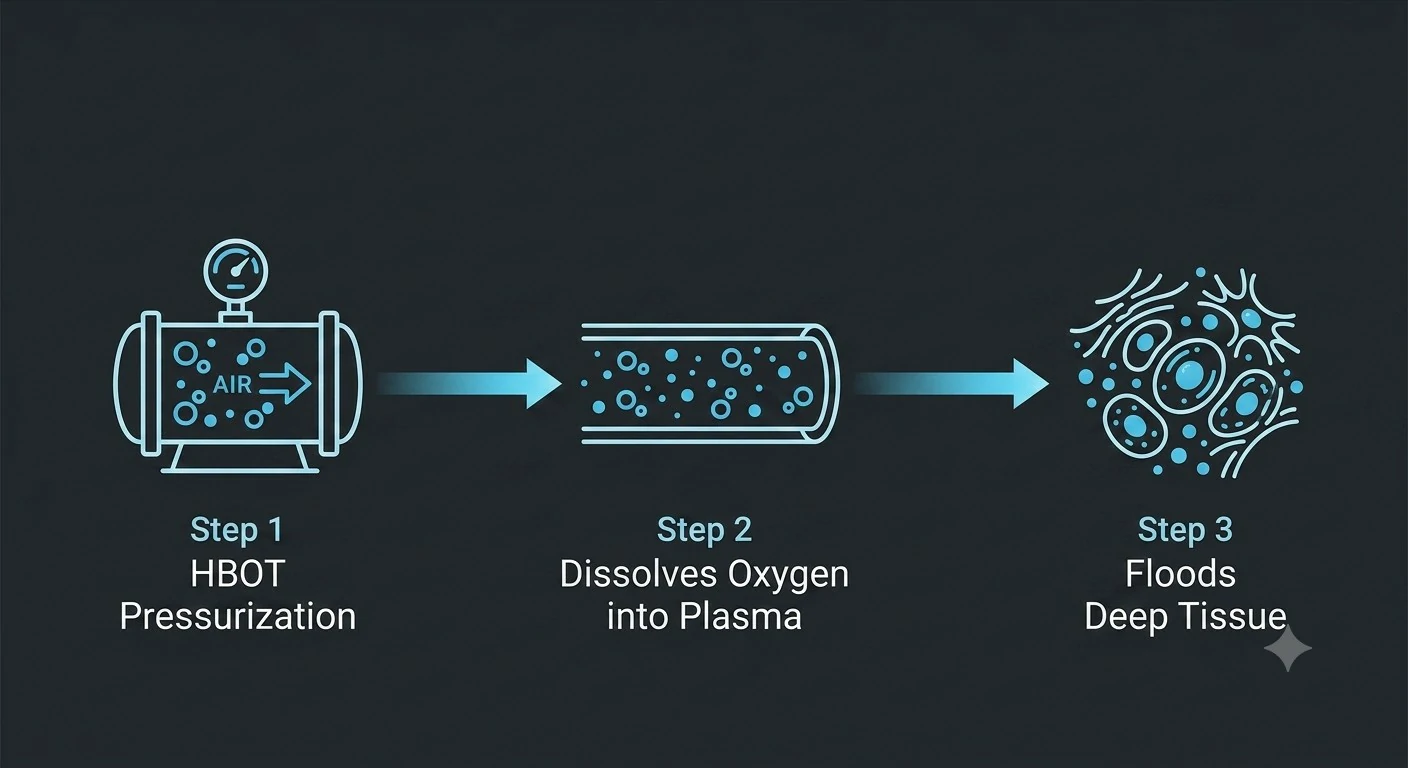
Hyperbaric Oxygen Therapy involves placing a user in a pressurized chamber and delivering high-purity oxygen. In normal air, the oxygen you use is carried almost entirely by the hemoglobin in your red blood cells.
HBOT defies the laws of physics. The increased pressure (usually 1.5 to 2.0 ATA in special professional chambers) forces oxygen into the blood plasma, cerebrospinal fluid and deep interstitial tissues. This greatly increases the oxygenation of the tissue , bringing essential resources to areas of poor blood flow .
However, supplying oxygen to the body is only half the battle. This raises a basic biological question: If oxygen is the end-all-be-all cellular fuel, then what determines how efficiently your cells can actually burn it?
Understanding Red Light Therapy: Activating the Cell’s Energy Machinery
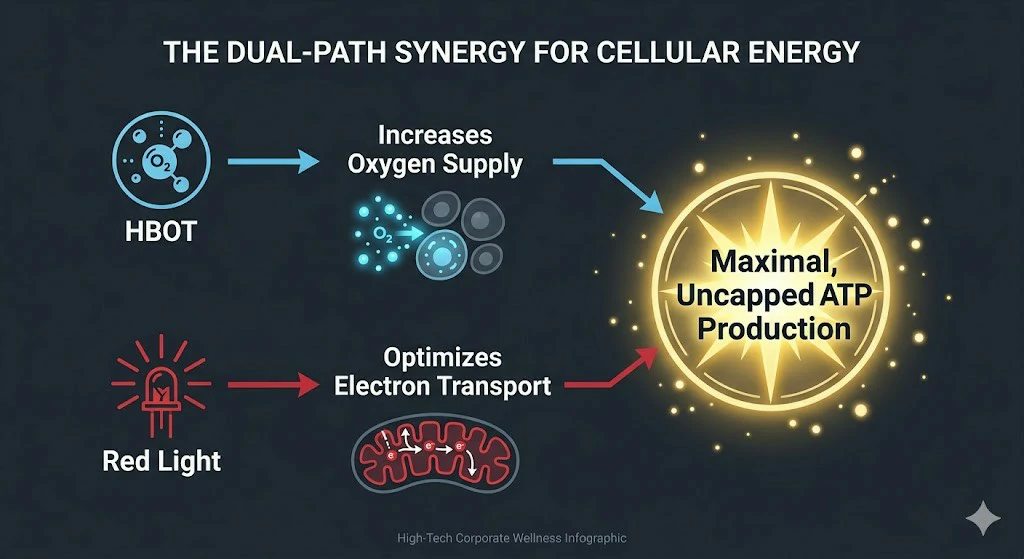
This is where Red Light Therapy and Near-Infrared Therapy come in. HBOT supplies the raw fuel (oxygen) and red light therapy opens the engine that processes it.
Red light (~660nm) and near-infrared light (~850nm) penetrate deeply into the skin and muscles to interact directly with a primary photoreceptor within our mitochondria known as Cytochrome C Oxidase.
Nitric oxide binds to Cytochrome C Oxidase in stressed or aging cells and essentially blocks oxygen from entering and stopping the production of Adenosine Triphosphate (ATP), the universal currency of energy of life. When red light hits the cell, it gently sweeps this toxic nitric oxide away, freeing the enzyme and forcing the mitochondria to ramp up ATP production.
-
HBOT provides the massive surge of oxygen.
-
Red Light Therapy ensures that the cell’s machinery is awake, optimized, and ready to use that oxygen.
The 3 Major Synergies Between HBOT and Red Light Therapy
When you combine these two mechanisms, you are at the same time removing two totally different biological bottlenecks. So these are the three big synergies that are created when you combine HBOT and photobiomodulation.
Synergy #1 Multi-pathway optimization for faster ATP production
In normal cellular respiration, energy production may be limited by lack of oxygen or by slow-acting enzymes in the mitochondria. These therapies, when combined, eliminate both rate-limiting steps simultaneously:
The dissolved plasma oxygen delivered by HBOT is fed into an incredibly efficient and highly receptive mitochondrial network primed by red light. The end result? A huge, uncapped spike in cellular energy that speeds up tissue repair, muscle recovery and neural performance.
Synergy #2: A Stronger, Two-Tiered Antioxidant Defense
One of the frequently asked questions about high-pressure oxygen therapy is the production of Reactive Oxygen Species (ROS), or free radicals. But a brief burst of ROS is a critical signaling mechanism for healing, and the body must know how to neutralize it.
-
During a series of sessions, HBOT naturally upregulates the body’s long-term internal antioxidant defense system by increasing the production of protective enzymes, including Superoxide Dismutase (SOD), Catalase, and Glutathione.
-
So what does Red Light Therapy do ? It immediately counteracts this effect by stimulating the ongoing production of mitochondrial melatonin , the most powerful scavenger of free radicals at the cellular level .
Together they form a double-layered shield; one builds up the cellular defense network, and the other provides immediate localized clearance of oxidative stress.
Synergy #3: A Multi-Stage Anti-Inflammatory Network
Inflammation is rarely purely systemic or purely localized but is rather a complex combination of the two.
-
HBOT has a systemic effect, down regulating pro-inflammatory cytokines throughout the body by changing gene expression.
-
Red Light Therapy goes for specific localized pathways . It inhibits the enzyme COX-2 and relieves swelling and pain exactly where the light is applied .
Together they constitute an integral whole-body-to-local anti-inflammatory network that exponentially accelerates structural recovery.
Red Light vs. HBOT: What’s the Difference?
To maximize your recovery protocols, it is important to remember that these two modalities do not replace one another—they are perfectly complementary opposites.
| Feature | Hyperbaric Oxygen Therapy (HBOT) | Red Light Therapy (PBM) |
| Primary Scope | Systemic (Whole-Body) | Localized & Targeted |
| Core Mechanism | Oxygen-based pressure delivery | Light-based photon absorption |
| Primary Target | Plasma and deep tissue oxygenation | Direct mitochondrial stimulation (ATP) |
| Systemic Effect | Stem cell mobilization & angiogenesis | Circulatory enhancement & cellular signaling |
Should You Use Red Light Before or After HBOT?
Determining the ideal sequence depends entirely on the operating pressure of your hyperbaric chamber and your specific clinical goals.
For Mild to Moderate HBOT (1.3 – 1.5 ATA)
-
Best Sequence: Red Light Therapy BEFORE HBOT.
-
Why it works: Exposure to red and near-infrared light induces a localized release of nitric oxide into the bloodstream. This triggers immediate vasodilation—the widening of blood vessels. When you step into a 1.3 or 1.5 ATA chamber immediately afterward, your expanded vascular network can distribute the newly dissolved oxygen much more effectively to your peripheral tissues and brain.
For High-Pressure HBOT (2.0 ATA and Above)
-
Best Sequence: Individualized protocols, or separating the sessions.
-
Why it matters: High-pressure medical environments (2.0 ATA and above) naturally induce a safe, protective state of vasoconstriction (narrowing of blood vessels) to manage oxygen delivery volumes. Because red light induces vasodilation, running these therapies back-to-back at higher pressures can occasionally send conflicting signals to the vascular system.
For advanced protocols, clinicians generally recommend personalizing the schedule based on your specific therapeutic goals or separating the sessions by a few hours to ensure absolute comfort and efficacy.
Who May Benefit Most From Combining This Duo?
Because this combination targets the absolute foundational energy factory of the human body, its practical benefits cross over into multiple wellness spaces:
-
Athletes & Biohackers: Exceptional for flushing lactic acid, reducing delayed onset muscle soreness (DOMS), and reaching peak physical output.
-
Brain Health Seekers: Highly effective for clearing stubborn brain fog, sharpening cognitive focus, and supporting neural energy demands.
-
Healthy Aging Advocates: Perfect for stimulating deep systemic collagen synthesis, reducing fine lines, and maintaining cellular youthful vitality.
-
Recovery Support: Ideal for individuals looking to naturally support and speed up structural tissue repair.
Can Red Light Therapy Be Used Inside a Hyperbaric Chamber?
As the demand for this combination grows, many users wonder if they can simply bring a red light panel inside a soft or hard hyperbaric chamber to save time.
The answer is a strict “it depends,” and DIY setups should be avoided entirely.
Oxygen-rich, pressurized environments are subject to rigid electrical safety standards. Bringing uncertified, consumer-grade electronic devices, batteries, or standard LED panels inside a pressurized oxygen chamber presents a severe fire hazard.
While some ultra-advanced, factory-certified hard chambers feature integrated, medically approved internal LED systems, you should never attempt to place an external red light device inside a chamber yourself. For your safety, stick to doing the therapies sequentially using standalone equipment.
Common Misconceptions About HBOT and Red Light Therapy
Myth #1: More Pressure Is Always Better
Many people assume that a 2.0 ATA chamber will always deliver twice the results of a 1.5 ATA chamber. In reality, mild-to-moderate pressures (1.5 ATA) paired with red light therapy are often the absolute sweet spot for general wellness, cognitive clarity, and athletic biohacking, providing profound cellular benefits without the rigorous physiological strain of deep medical pressures.
Myth #2: One Session Is Enough to See Permanent Changes
Both HBOT and red light therapy rely on cumulative cellular signaling. While a single combined session will leave you feeling remarkably refreshed and energized, true structural shifts—such as blood vessel growth (angiogenesis) and long-term mitochondrial optimization—require a consistent protocol over several weeks.
Myth #3: You Must Choose One or the Other
Because they are both premium wellness investments, users often try to choose which one is “better.” As demonstrated by their distinct cellular pathways, they are team players. Choosing one over the other means missing out on the compounding rewards of their multi-pathway synergy.
The Future of Integrated Recovery Therapies
The wellness landscape is moving rapidly away from isolated, single-device treatments and shifting toward unified, multi-modality ecosystems. Combining Hyperbaric Oxygen Therapy with Red Light Therapy represents the pinnacle of this shift—targeting the cell from the outside in with pure oxygen, and from the inside out with cellular photobiomodulation.
By integrating these two powerhouses into your routine, you aren’t just recovering; you are actively giving your body the ultimate cellular advantage.
Frequently Asked Questions (FAQ)
Is red light therapy better than HBOT?
Neither is better; they are completely different and complementary. HBOT floods your body with systemically dissolved oxygen, while red light therapy optimizes your mitochondria to utilize that oxygen efficiently.
Can I do red light therapy and HBOT on the same day?
Yes. In fact, doing them on the same day is highly recommended to take full advantage of their cellular synergy.
Does red light therapy increase ATP?
Yes. Red light therapy specifically stimulates the Cytochrome C Oxidase enzyme inside the mitochondria, removing nitric oxide blockages and directly increasing ATP (energy) production.
Why do clinics combine HBOT with red light therapy?
Clinics pair them because HBOT provides the essential oxygen fuel, while red light optimizes the cellular machinery required to burn that fuel, resulting in drastically accelerated recovery times.
Should red light be done before or after HBOT?
For soft chambers and wellness protocols (1.3 to 1.5 ATA), doing red light before HBOT is ideal because it dilates blood vessels and enhances oxygen delivery. For clinical pressures of 2.0 ATA and above, consult an expert or separate the sessions.
Can red light therapy replace HBOT?
No. Red light cannot dissolve medical-grade volumes of oxygen into your blood plasma or mobilize stem cells the way a pressurized hyperbaric chamber does.
Is HBOT more effective with red light therapy?
Yes. Providing excess oxygen (HBOT) to an optimized cellular engine (primed by red light) allows the body to process energy and repair tissue much faster than doing HBOT alone.
